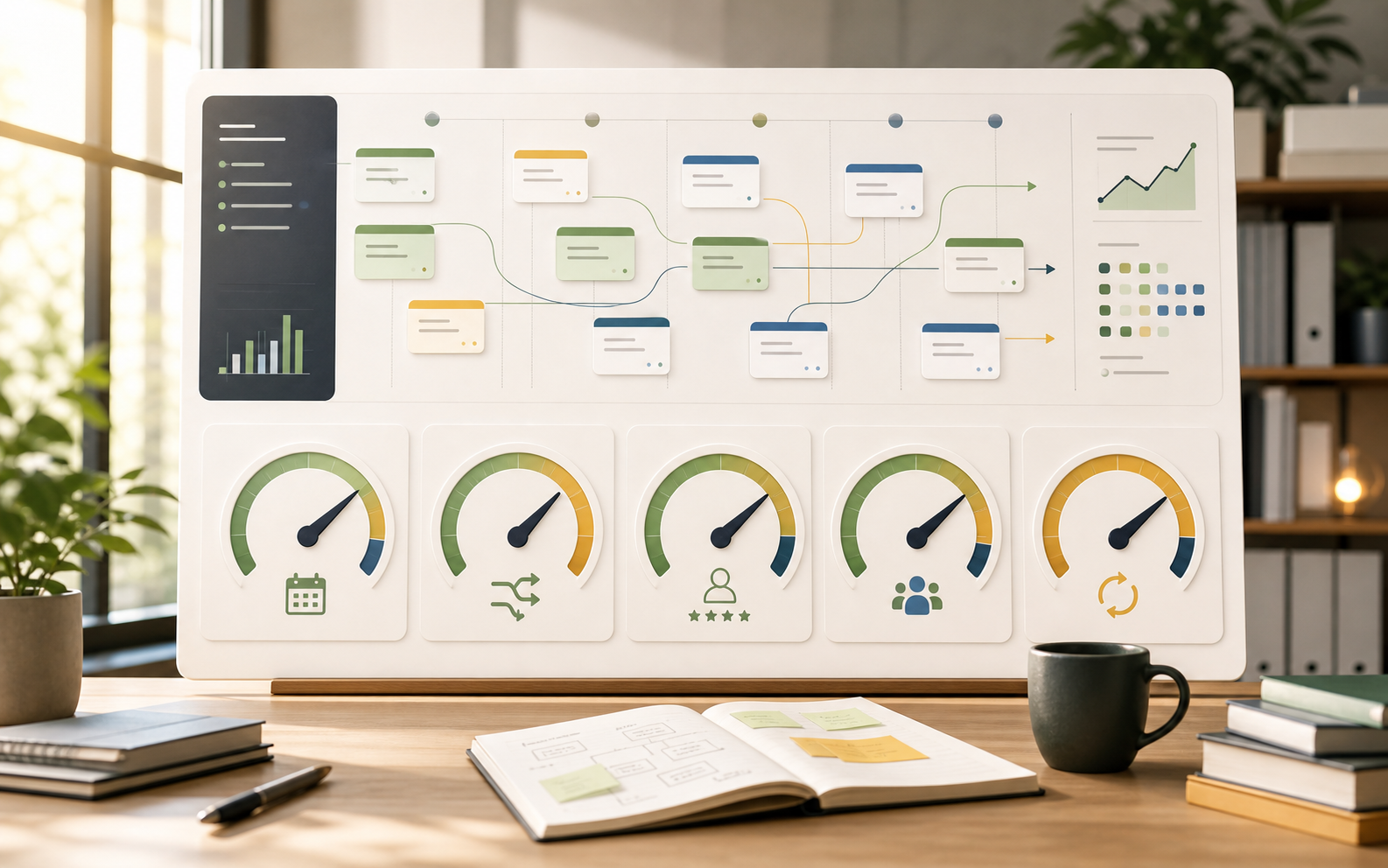
A tidy board does not tell you how delivery feels.
A team can have clean ceremonies and still move slowly. The standup happens, the board is tidy, the retro is on the calendar, and yet every release needs a small rescue operation. That is the point where an Agile maturity assessment has to leave the checklist behind.
To measure Agile maturity in a useful way, look at what happens to important work after it enters the system. Does the team understand the problem quickly? Can priorities change without a reset? Does customer feedback reach the people making trade-offs? Can the team release without everyone holding their breath?
The useful question is not "Are we Agile enough?" It is "Where does useful work lose momentum, and what would make the next release easier?"
Follow one piece of work through the system.
Pick something recent, preferably from the last month: a product change, a bug fix that mattered, or a small customer request. Trace it from the first signal to production. The details usually tell the story.
Maybe discovery was quick but approval waited four days. Maybe engineering finished the change, then testing created a queue. Maybe deployment depended on one person. Maybe the demo created rework because the team heard the customer signal too late. None of that shows up in a ceremony checklist, but it is exactly where delivery maturity lives.
Use a small model the team can argue with.
For a team discussion, look at the five areas below. The short survey linked here asks a different set of questions and combines them into one score; it does not measure these areas separately:
- Release confidence: can the team ship a useful change without turning the week into a coordination event?
- Change flow: when new information arrives, can the plan bend without becoming chaos?
- Customer feedback: does real user or buyer evidence reach product decisions while it can still matter?
- Team ownership: can the team improve the way work moves, or does every fix wait for permission from above?
- Improvement loop: after a retro, metric review, or incident, does anything visibly change in the delivery system?
Ask questions that can be answered from recent memory.
Good assessment questions should not invite aspiration. Ask about what actually happened last month.
- What was the last release that made people nervous, and why?
- Which decision waited too long for the amount of risk involved?
- What customer feedback changed the roadmap or should have changed it?
- Which blocker has shown up more than once?
- After the last release problem, what became easier the next time?
Use the discussion to choose a change.
A score can start the conversation. Recent work should help you choose what to try next, such as a smaller release or a shorter wait for a decision.
If release confidence is weakest, the answer may be smaller deployable slices, clearer production ownership, fewer manual checks, or a simpler approval path. If change flow is weakest, the team may need better decision rules before it needs another planning meeting.
Know when the pattern is bigger than the team.
Sometimes the assessment points beyond a single squad. A roadmap committee may be creating slow priority changes. Architecture may make every release risky. Support and product may be learning from customers, but that learning may never reach the backlog. In that case, the next step is not to coach the team harder. It is to change the system around the team.
That is where an Agile maturity assessment becomes useful for leadership. It turns vague delivery frustration into a small set of observable constraints: release confidence, change flow, customer feedback, team ownership, and the improvement loop.
The test: can next week look different?
After you measure Agile maturity, the team should be able to name one thing it will try next week. Not a transformation theme. One concrete change: shorten a review queue, release a smaller slice, invite customer evidence into planning, or give the team authority over a repeated blocker.
If the assessment creates that conversation, it is doing useful work. If it only produces a score, it has become another process ritual.
Related insights